
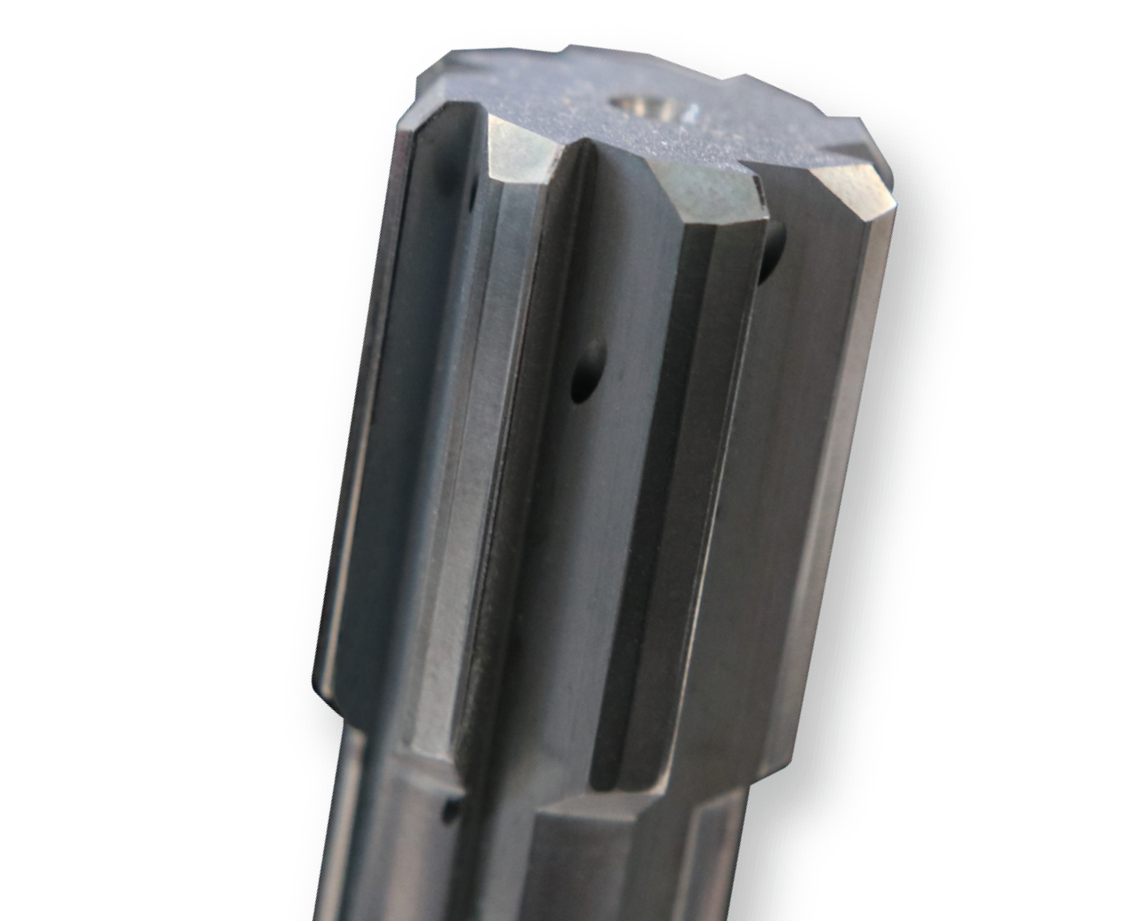
Custom Coolant-Fed Reamer Triples Tool Life and Saves $2.1 Million Annually
Same speed. Same feed rate. More than three times the parts.
Fullerton engineered a custom coolant-fed reamer that increased output from 60 to 200 parts per tool while reducing part machining costs by 48%. For this automotive manufacturer, those improvements added up to $2.1 million in annual savings.
At a Glance
The Challenge
An automotive manufacturer needed to ream high volumes of iron components — an application that was putting its existing tooling to the test.
Standard reamers weren't lasting long enough to meet production goals. The customer was getting only 60 parts per tool, leading to frequent replacements, additional tool changes, and higher machining costs.
They didn't need to push the machine harder. They needed a reamer that could hold up longer.
The Solution
Fullerton engineered a custom reamer around the material, application, and wet machining environment. The custom design featured:
- FC-18 coating to provide the wear resistance needed for machining iron
- Coolant-thru holes to deliver coolant directly to the cutting edge and better manage heat
To provide a true side-by-side comparison, the Fullerton custom reamer and the competitor's reamer were tested at the same speed and feed rate.
No easier cutting conditions. No slowing down the process. Just a reamer designed to do the job better.
The Results
The custom coolant-fed reamer delivered major improvements in both tool life and cost per part:
- 200 parts per tool: The Fullerton reamer produced 200 parts compared to 60 with the competitor's tool.
- 3.3× longer tool life: The customer more than tripled the number of parts produced before replacing the reamer.
- 48% lower part machining costs: Longer tool life meant fewer replacements and fewer production interruptions.
- $2.1 million in annual savings: The improvements in tool life and cost per part delivered significant savings across the operation.
The same machining conditions. More than three times the output. And far fewer tool changes getting in the way of production.
Why Coolant-Thru Holes and FC-18 Matter
Iron machining can generate significant heat and abrasive wear at the cutting edge. When coolant can't effectively reach that area, tool life can drop quickly.
Coolant-thru holes deliver coolant directly where the cutting is happening instead of relying only on external flood coolant. This helps control heat during continuous reaming and supports more consistent tool performance.
Pairing that coolant delivery with Fullerton's wear-resistant FC-18 coating helped the reamer maintain its cutting edge through significantly more parts. In this application, that combination increased output from 60 to 200 parts per tool.
When Does a Custom Coolant-Fed Reamer Make Sense?
A custom coolant-fed reamer may be worth evaluating when:
- You're reaming iron, cast iron, or another abrasive material
- Standard reamers aren't reaching your production targets
- Frequent tool changes are increasing downtime and cost per part
- Wet machining is available, but coolant isn't effectively reaching the cutting edge
- You want to benchmark a new reamer against your current tool under identical conditions
If your reamer is calling it quits long before your production run does, it may be time for a tool designed around the application.
Frequently Asked Questions
How much did the custom reamer save annually? +−
The custom coolant-fed reamer saved the automotive manufacturer $2.1 million annually. The savings were driven by a 48% reduction in part machining costs and a 3.3× improvement in parts produced per tool.
How many parts did the Fullerton reamer produce? +−
The Fullerton custom reamer produced 200 parts per tool compared to 60 parts with the competitor's reamer. Both tools were tested at 14 IPM and 200 SFM.
What material was the custom reamer designed for? +−
The custom reamer was designed for machining iron components in a high-volume automotive application.
What features were included in the custom reamer? +−
The reamer featured an FC-18 coating for wear resistance and coolant-thru holes that delivered coolant directly to the cutting edge.
How much did part machining costs decrease? +−
Part machining costs decreased by 48% because of the reamer's longer tool life, reduced replacement frequency, and fewer tool changes.
Reamer Quitting Before Your Production Run Does?
Tell us about your material and application and our engineering team will design a tool around it.
